Practice Business English with AI: Speak Up Without Fear of Mistakes
Published on 12 min read

Table of contents
You can read English without effort and follow emails and slide decks, but when it is your turn to speak in a meeting, the words get stuck. To practice business English out loud, one simple thing is often missing: someone available, patient and non-judgmental to talk to. A voice-based conversational AI can play that part.
This article is for professionals and students who want to practise speaking English with AI, and also for schools, training providers, international companies and teams on the move who need their learners to speak regularly. You will find ten workplace situations with key phrases and vocabulary, a four-week plan, criteria to track your progress, and a guide to building scenarios for a whole class. You can also try the free demo right away, with no account.
Why speaking business English is so hard
Understanding a language and speaking it are two different skills. Speaking means building sentences in real time, without a safety net, in front of someone. Three obstacles come up again and again.
Fear of making mistakes
You look for the perfect sentence before you open your mouth, so you speak little and late. In a meeting, a colleague voices your idea first, or the moment simply passes. A grammar slip is rarely the real problem: silence is. At work, worrying about what a client, a manager or a whole team will think makes the block even stronger.
Not enough practice
Many learners have solid grammar and vocabulary but hardly speak during the week. In a group class, speaking time is shared among everyone. Yet fluency is built like an athletic movement, through short and frequent repetitions.
No one to practise with
Finding someone to role-play a customer call or a negotiation, at the right moment and at your level, is not easy. Colleagues are busy, a private tutor costs time and money, and you hesitate to ask a native speaker to replay the same scene ten times. As a result, your first real speaking attempt in a high-stakes situation is also your first rehearsal.
What changes when you practise English conversation with an AI by voice
In a conversational simulation, you speak (or type) to a virtual counterpart who answers what you actually say. On AI-Coaching, simulations run in text or voice, including in the free demo. Four concrete benefits:
- Repetition without judgment. You can make mistakes, hesitate, rephrase and replay the same scene as many times as you need. Nobody gets impatient and nobody grades your accent.
- Availability at any hour. Fifteen minutes before a meeting, on the train, or in the evening after work: the session fits your schedule, not the other way round.
- Workplace situations. The counterpart is not a phrasebook. It plays a customer, a supplier, a recruiter or a colleague, with a specific context and goal, and it reacts to your sentences.
- Structured feedback. An AI observer gives discreet tips during the conversation, then a detailed debrief reviews what worked and what to work on.
Let us be clear about the limits: an AI does not replace a teacher or real conversations with English-speaking colleagues. It is a warm-up. It lets you walk into the real meeting with several rehearsals already behind you. For detailed pronunciation correction or exam preparation, a trainer is still valuable.
Practice business English: 10 situations to role-play
For each situation you will find a goal, a few key phrases and some vocabulary. These are supports to adapt, not lines to recite: first play the scene in your own words, then compare with the suggested wording.
1. Introducing yourself
Goal: say in 30 to 45 seconds who you are, what you do and what you expect from the conversation.
- I'm in charge of customer support for the European market.
- I've been working in logistics for six years.
- My role is to make sure that our clients get answers quickly.
Vocabulary: background (your education and experience), responsibilities (what you are accountable for), to be in charge of (to manage).
2. Taking part in a meeting
Goal: speak up at the right moment, give your opinion, ask for clarification, rephrase.
- Could I add something here?
- I see your point, but I'd suggest a different approach.
- Let me clarify what I mean.
Vocabulary: agenda (list of topics), action item (a task someone must do), to follow up (to check progress or reply later), deadline (the date something is due), to be on the same page (to agree on the essentials).
Common trap: say I agree, not I am agree.
3. Leading a customer call
Goal: open the conversation, ask open questions, summarise and announce what happens next.
- Thank you for taking the time to speak with me today.
- Could you tell me more about your current process?
- Let me summarise what we've agreed, and the next steps.
Vocabulary: requirements (what the customer needs), timeline (the schedule), next steps (what happens after the call).
Common trap: actually means "in fact", but many learners confuse it with the word for "currently" in their own language. To say "at the moment", use currently.
4. Negotiating
Goal: defend your position, offer something in return, and close without upsetting the other side. To work on the substance of a sales negotiation, see our page on sales negotiation with an AI simulator.
- We could agree to that price if you commit to a longer contract.
- That's slightly above our budget.
- Could we meet halfway?
Vocabulary: terms (the conditions of an agreement), discount (a price reduction), to commit (to promise firmly), trade-off (what you give up to get something else), to close the deal (to finalise the agreement).
5. Making small talk
Goal: keep a light conversation going for a few minutes at the start of a meeting, at the coffee machine or during a visit.
- How was your flight?
- Have you been to Lyon before?
- What do you like to do outside of work?
Vocabulary: to catch up (to exchange news), to be based in (to live and work in), weekend plans (what you will do on Saturday and Sunday).
6. Going through a job interview in English
Goal: present your background and illustrate your strengths with concrete examples. A simple structure helps: situation, task, action, result. If you want to see the other side of the table, our page on the recruitment interview simulator covers the recruiter's exercise.
- Could you walk me through your CV?
- One of my main strengths is working under pressure.
- In my last role, I was responsible for a team of five.
Vocabulary: strengths and weaknesses (what you do well and what you are improving), achievement (a result you are proud of), to handle (to deal with), notice period (the time you must work before leaving a job), salary expectations (the pay you are looking for).
7. Handling a customer complaint
Goal: acknowledge the problem, stay calm, offer a solution. Our page on handling an unhappy customer in simulation describes the method in more detail.
- I'm sorry to hear that. Let me see what I can do.
- Here is what I suggest: we send a replacement today.
- I understand how frustrating this must be.
Vocabulary: refund (money given back), replacement (a new item sent instead), delay (lateness), to escalate (to pass to a manager).
8. Presenting a product or service
Goal: explain clearly what the product does, who it is for and what makes it different.
- What sets it apart is how simple it is to set up.
- In practice, this means your team saves time every week.
- Let me show you how it works.
Vocabulary: feature (a function of the product), benefit (what the customer gains), pricing (how the product is charged), to roll out (to deploy).
9. Speaking on the phone
Goal: get your message across without gestures or faces. The phone is often harder than a video call because you can rely only on your voice. Our page on the AI phone call simulator shows how to practise these exchanges.
- Could you spell that, please?
- Sorry, could you speak a little more slowly?
- Let me repeat that to make sure I got it right.
Vocabulary: to hold the line (to wait on the phone), to put someone through (to connect a caller), to leave a message (to record or pass on information), to call back (to phone again later).
10. Introducing yourself at a trade show
Goal: start a conversation with a stranger, describe your activity in one sentence, exchange contact details.
- What brings you to the show?
- We specialise in training solutions for sales teams.
- Can I give you my card? Let's keep in touch.
Vocabulary: booth (a company's stand), exhibitor (a company with a stand), lead (a potential customer), to follow up (to contact someone after the event).
A four-week plan to build your speaking confidence
Short, regular sessions beat one long session. Plan three or four 15-minute sessions per week. Each week has one simple goal.
| Week | Situations | Goal at the end of the week |
|---|---|---|
| 1. Get unblocked | Introducing yourself, small talk | Speak for two minutes without stopping, even with mistakes |
| 2. Everyday work | Meetings, phone calls | Ask people to repeat, rephrase, speak up without waiting to be asked |
| 3. High-stakes situations | Customer call, complaint, product presentation | Structure an answer: short reply, example, question back |
| 4. Demanding situations | Negotiation, interview, trade show | Replay the week 1 scene and compare |
A typical 15-minute session goes like this:
- Prepare three key phrases for the situation (two minutes).
- Play the scene out loud, without looking at your notes (ten minutes).
- Read the debrief and note two points to improve (two minutes).
- Replay the scene the next day, applying those two points.
Three habits help: speak out loud rather than in your head, accept imperfection, and learn rescue phrases such as What I mean is... or How do you say... in English? so you keep going when a word is missing.
How to measure your progress: the debrief and four criteria
Counting grammar mistakes is a poor indicator: you can make fewer mistakes simply because you speak less. Four criteria give a fairer picture of what you want to achieve when speaking at work.
| Criterion | Sign of progress | Sign to work on |
|---|---|---|
| Clarity | The main message is understood from the first sentence | Long detours, several ideas in a single sentence |
| Fluency | Short pauses, quick recovery after getting stuck | Frequent stops, sentences abandoned halfway |
| Vocabulary | Precise work terms, little repetition | Generic words (thing, stuff), word-for-word translation from your own language |
| Interaction | Follow-up questions, rephrasing, reacting to the other person | Isolated answers, no question back |
To make the measurement useful, replay the same scenario in week 1 and week 4, then compare the two detailed debriefs. If you coach a group, the grid above can serve as the basis for the instructions given to the AI observer, and the platform's progress tracking lets you compare one person's sessions over time.
One useful caveat: a simulation gives teaching feedback, not an official level. It does not replace a recognised test or a teacher's opinion, and we do not promise any measured result.
Schools and training providers: building scenarios for a class
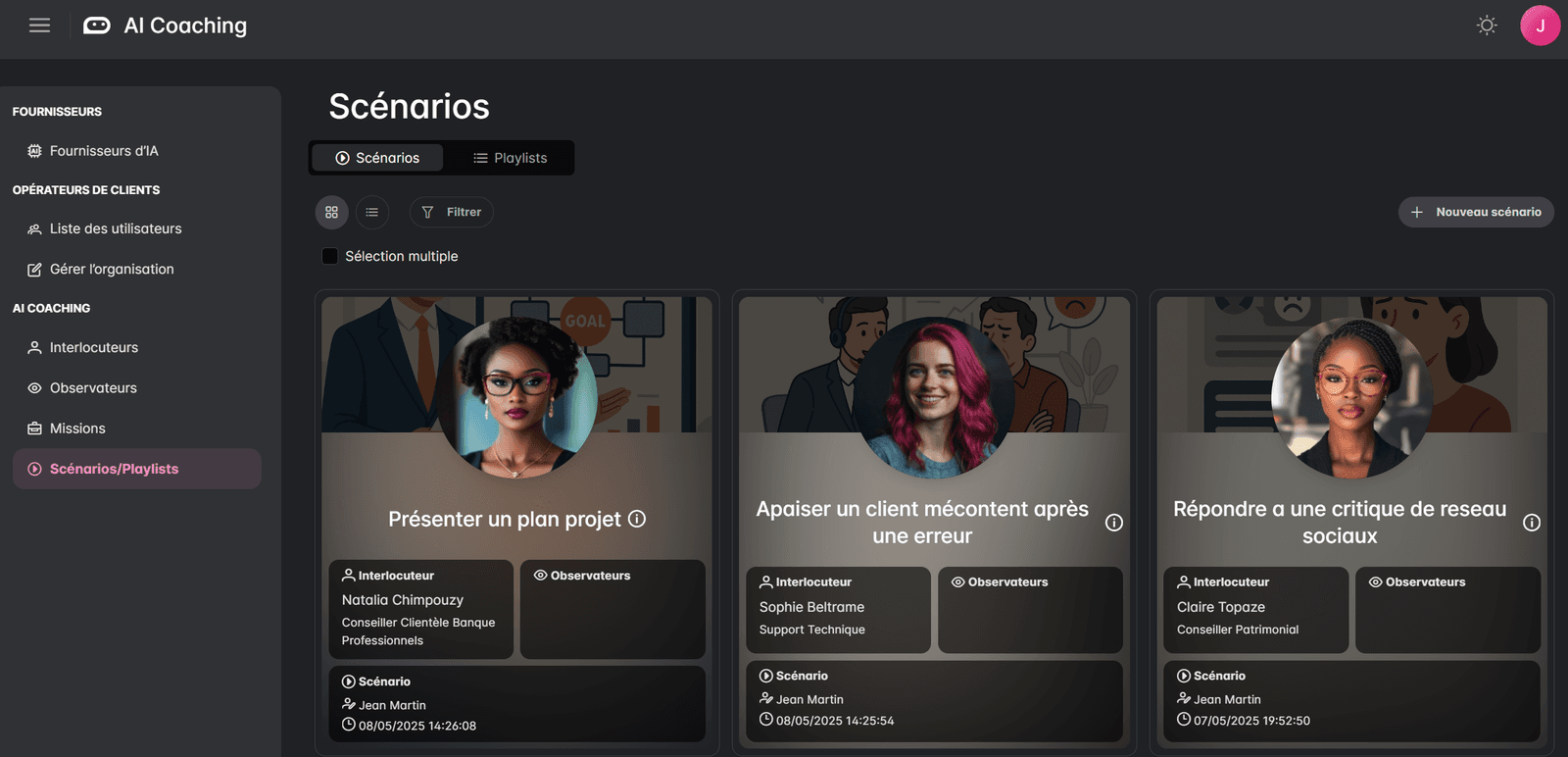
A teacher or trainer does not depend on a fixed catalogue. They can build their own situations and make them available to learners. Our page on the AI simulator for schools describes the teaching use in detail; here is the general logic.
- Define the goal. For example: lead a customer follow-up call in English, or present a product in three minutes.
- Configure the counterpart. Role, personality, context: a customer in a hurry, a hesitant supplier, a very structured recruiter.
- Enrich the scenario with your documents. Product sheet, course glossary, internal procedure, case study: scenarios draw on your documents (RAG) to stay close to the target job.
- Choose text or voice. The language model and voice engine (ElevenLabs, OpenAI Realtime or Azure Speech) are chosen according to the language and the need.
- Share by link. Scenarios reach a class through secure links, with an expiry date and a usage limit.
- Follow progress. Learning paths and playlists chain scenarios in a teaching order, and progress tracking shows who is moving forward.
For training providers, SCORM is available: scenarios can be integrated into a path in your LMS. The platform runs in the cloud or as a local installation, depending on your data constraints.
The same logic applies to international companies and teams on the move: preparing an employee who is joining a subsidiary abroad, letting a sales team rehearse before a trade show, or helping newcomers get through their first meetings. You keep control of the teaching content, and the AI provides the repetition.
The same approach in other languages
AI-Coaching is multilingual: simulations run in the language of your teams. What you have just read about English therefore applies to other language and job combinations.
- A salesperson preparing a meeting in Spanish or German rehearses the pitch and the answers to objections before facing the customer.
- A foreign colleague learning business French practises welcoming customers, phone calls or team meetings.
- A modern-languages class gets a guided conversation between two lessons, with one scenario per topic studied.
The quality of the exchange depends on the language, model and voice chosen: always test a scenario before rolling it out to a group.
Where to start
The free demo, available without an account, offers two English scenarios with a virtual English tutor: Learning English : Meeting a friend in the street and Learning English : Exchanging a train ticket. These are everyday situations rather than pure business, but they work as a warm-up for small talk and for a service exchange, two useful foundations before the workplace situations. The list changes over time: find it on the AI role-play demo page.
- Try one of the two English scenarios, by voice, for ten minutes.
- Then pick a situation from the list above, the one you dread most.
- If you represent a school, a training provider or a company, request a demonstration to build your scenarios with us.
Frequently asked questions
Can you really practise speaking English with an AI?
Yes, for practice: you speak out loud to a virtual counterpart that reacts to your sentences in a specific situation. This builds fluency and ease, provided you play regularly. It does not replace a teacher for in-depth corrections.
Do you need a minimum level to start?
It is better to be able to build simple sentences. For beginners, a teacher can prepare short, guided scenarios by configuring the counterpart's personality and the instructions of the situation. In every case, the key is to start with familiar situations, such as introducing yourself.
Does the AI correct my pronunciation and grammar?
The observer gives tips during the conversation and the detailed debrief reviews the exchange: what you said, what worked and what to improve. We do not promise detailed phonetic assessment or level certification: for that, rely on a teacher and a recognised test.
Can a teacher share scenarios with a whole class?
Yes. Scenarios are shared through secure links with an expiry date and a usage limit, and can be grouped into learning paths or playlists. The platform is multilingual, so the same method works for languages other than English.
Tags
Share this article