Table of contents
Nonviolent communication exercises are the best way to move from an appealing idea to a real skill. Everyone agrees on "communicating better", yet when a tense moment arrives at work, few people can say anything other than "you are driving me crazy" or "this is unacceptable".
This article briefly recalls where nonviolent communication (NVC) comes from, walks through its four steps (observation, feeling, need, request, known in French as OSBD) with workplace examples, offers six hands-on exercises, five work situations handled step by step, and the most common mistakes. It ends with a concrete way to practise out loud: the free AI-Coaching demo includes a "Coaching CNV" scenario with a nonviolent communication coach, with no account to create (see the demo).
Nonviolent communication in brief: origin and principle
NVC was developed by the American psychologist Marshall B. Rosenberg (1934-2015). He held a doctorate in clinical psychology and founded the Center for Nonviolent Communication (CNVC) in 1984. According to the biography published by CNVC, his approach grew out of his work with civil rights activists in the 1960s. His best-known book, Nonviolent Communication: A Language of Life, first appeared in 1999.
The principle is simple to state. As the first chapter of the book, published by CNVC, puts it, NVC invites you to focus your attention on four things: what you observe, what you feel, what you need and what you request. CNVC stresses that the essence lies in being aware of these four components, not in the exact words exchanged. In other words, it is not a script to recite but a way of finding your bearings when a conversation tightens up. The four components work in both directions: expressing them yourself and hearing them in the other person.
In French-speaking countries the model is known by the acronym OSBD (Observation, Sentiment, Besoin, Demande). In English it is often abbreviated OFNR (Observations, Feelings, Needs, Requests).
The four steps of the model, with workplace examples
1. Observation: describe the facts, without judgement
An observation is what a camera could record: a fact, a figure, a sentence you heard. It can be verified and contains no interpretation or generalisation ("always", "never").
"The report arrived on Thursday although we had agreed on Tuesday." is an observation. "You are disorganised." is a judgement.
2. Feeling: name what you feel
Here you say what is going on inside you, using a real feeling word: worried, annoyed, disappointed, relieved, enthusiastic. Words that carry a disguised reproach ("I feel ignored", "I feel manipulated") actually describe what you think the other person is doing: they are interpretations.
"I am worried." is a feeling. "I feel ignored." points to a judgement about the other person.
3. Need: connect the feeling to what matters
A feeling is information about a need that is met or unmet: safety, respect, clarity, autonomy, recognition, cooperation, support. According to CNVC, needs are universal, shared by all people, and not specific to one individual. A need is not a strategy: "you warning me in advance" is a strategy, "having visibility on deadlines" is a need.
"I need visibility on deadlines so that we can keep our commitments to the client."
4. Request: formulate a concrete action
The request says what you would like the other person to do, here and now, in a way that is specific, positive and realistic. CNVC insists on the difference from a demand: a request leaves the other person free to say no. If a refusal is not accepted, it was not a request.
"Would you be willing to let me know as soon as a deadline looks likely to slip, by message before noon?"
Put together, the four steps give, for example: "The report arrived on Thursday although we had agreed on Tuesday (observation). I am worried (feeling), because I need visibility so that we can keep our commitments to the client (need). Would you be willing to tell me as soon as a deadline looks likely to slip? (request)"
| Step | Question to ask yourself | Usual pitfall |
|---|---|---|
| Observation | What would a camera have recorded? | Mixing fact and interpretation |
| Feeling | What is going on inside me? | Saying "I feel that..." followed by a judgement |
| Need | What matters to me here? | Confusing a need with a solution |
| Request | What specific action can I ask for? | Making a demand or a vague request |
6 nonviolent communication exercises to practise
Allow ten to fifteen minutes per exercise. Do them in writing first, then out loud: the method only becomes useful when it comes out naturally at the right moment.
Exercise 1: turn a judgement into an observation
Instructions. Write down five judgements you have had this week about colleagues, customers or your manager. For each one, find the specific fact that triggered it by asking what a camera would have filmed.
Example. "Lea is not committed" becomes "Lea did not speak in the last three team meetings."
How to check. Your sentence contains no "always", no "never" and no adjective describing the person. Someone else who was present would confirm it.
Exercise 2: build your list of feelings
Instructions. In two minutes, write every feeling word you know. Then complete it with a reference list. Sort them into two columns, pleasant and painful, then turn three pseudo-feelings ("I feel betrayed", "I feel belittled") into real feelings (disappointed, sad, worried).
Example. "I feel ignored by my team" becomes "I am sad and a little discouraged."
How to check. The word you chose describes your inner state, not the supposed behaviour of the other person.
Exercise 3: connect feeling and need
Instructions. Choose a strong emotion from this week. Complete the sentence "I am [feeling] because I need [need]". If the need you write contains a person's name or an action ("Paul to stop..."), it is a strategy: look for the value it serves.
Example. "I am annoyed because Paul arrives late" becomes "I am annoyed because I need reliability and respect for my time."
How to check. You can imagine anyone in your place having that same need.
Exercise 4: make a request
Instructions. Turn three complaints into requests. A good request is specific (who, what, when), positive (what you want rather than what you do not want), realistic and negotiable.
Example. "Stop interrupting me" becomes "During Monday's meeting, could you let me finish my sentences before reacting?"
How to check. The other person can answer yes or no, and you know what you will do if the answer is no.
Exercise 5: empathic listening
Instructions. In pairs, one person talks about a work frustration for three minutes. The other does not advise, reassure or compare: they reflect back the feeling and need they perceive, as a question. "Are you worried because you need visibility?" The speaker corrects or confirms.
Example. "My boss changes priorities every day" becomes "Are you exhausted because you need stability to see your work through?"
How to check. The speaker said "yes, exactly" at least once, and you did not give a single piece of advice.
Exercise 6: receive criticism
Instructions. Take a criticism you received recently. Write four replies: one that apologises, one that justifies, one that counter-attacks, then an NVC reply that first seeks to understand the other person's observation, feeling and need: "Are you disappointed that I did not send the minutes, because you need to move forward on your file?"
Example. Criticism: "You never think of us." NVC reply: "Would you like me to involve you earlier in decisions, because you need visibility on what affects you?"
How to check. Your reply contains neither defence nor reproach, and asks a sincere question that lets the other person clarify.
5 workplace situations handled with NVC
1. Manager and employee: repeated lateness
Instead of "You are always late, it is becoming unbearable", try: "This week you arrived after 9:30 at three team meetings (observation). I am concerned (feeling), because I need the team to be able to start together (need). Can you tell me what makes the start of these meetings difficult for you? (request)" Our page on the difficult conversation simulator for managers offers more situations of this kind.
2. An unhappy customer
Not a mechanical "I understand your frustration", but empathic listening: "If I understand correctly, this is the second time the delivery has arrived late, you are exasperated and you need to be able to count on our lead times?" Once the customer feels heard, move to the request: "Would you be willing for me to call you back tomorrow at 10 a.m. with a firm date?" The full method is in our guide to handling an unhappy customer.
3. A disagreement with a colleague
"When I see that the shared file has been changed without my being told (observation), I am surprised and a little worried (feeling), because I need to know what is up to date (need). Could we agree on a message in the team channel before any major change? (request)"
4. A tense meeting
When two people talk over each other, naming the dynamic rather than the people helps: "I notice several of us have been talking at once for ten minutes (observation). I feel a bit lost (feeling) and I would like everyone to be heard (need). Could we go round the table for two minutes each before deciding? (request)"
5. Giving feedback
Feedback is easier to hear when it describes a fact and its effect, not a character trait: "In yesterday's presentation, the figures on page 4 were not those of the latest export (observation). I was uncomfortable in front of the client (feeling), because I need to be able to rely on accurate data (need). Could you review the figures with me before each send-out? (request)" Performance reviews are an ideal testing ground: see the annual review simulator.
Common mistakes
- Reciting the formula. "When you..., I feel..., because I need..." word for word sounds artificial. CNVC insists on awareness, not on the words.
- Hiding a judgement inside a feeling. "I feel betrayed" or "I feel that you do not care" is still a reproach.
- Confusing a need with a strategy. "I need you to listen to me" is already a request, not a need.
- Turning the request into a demand. If the other person's refusal triggers your anger, it was a demand.
- Using NVC as a weapon. Curtly restating the other person's "need" on their behalf is manipulation, not empathy.
- Ignoring time and place. An important conversation does not belong in a corridor or a plenary meeting. Choose a calm setting.
- Trying to say everything at once. One observation, one feeling, one need, one request: one idea per step.
Practising with an AI conversation partner
The difficulty with NVC is not understanding it: it is applying it when the other person reacts badly and emotions rise. Reading is not enough. You need to rehearse out loud, facing someone who answers back. A virtual conversation partner has three advantages here: it is available at any hour, it does not judge you, and you can replay the same scene as many times as you need.
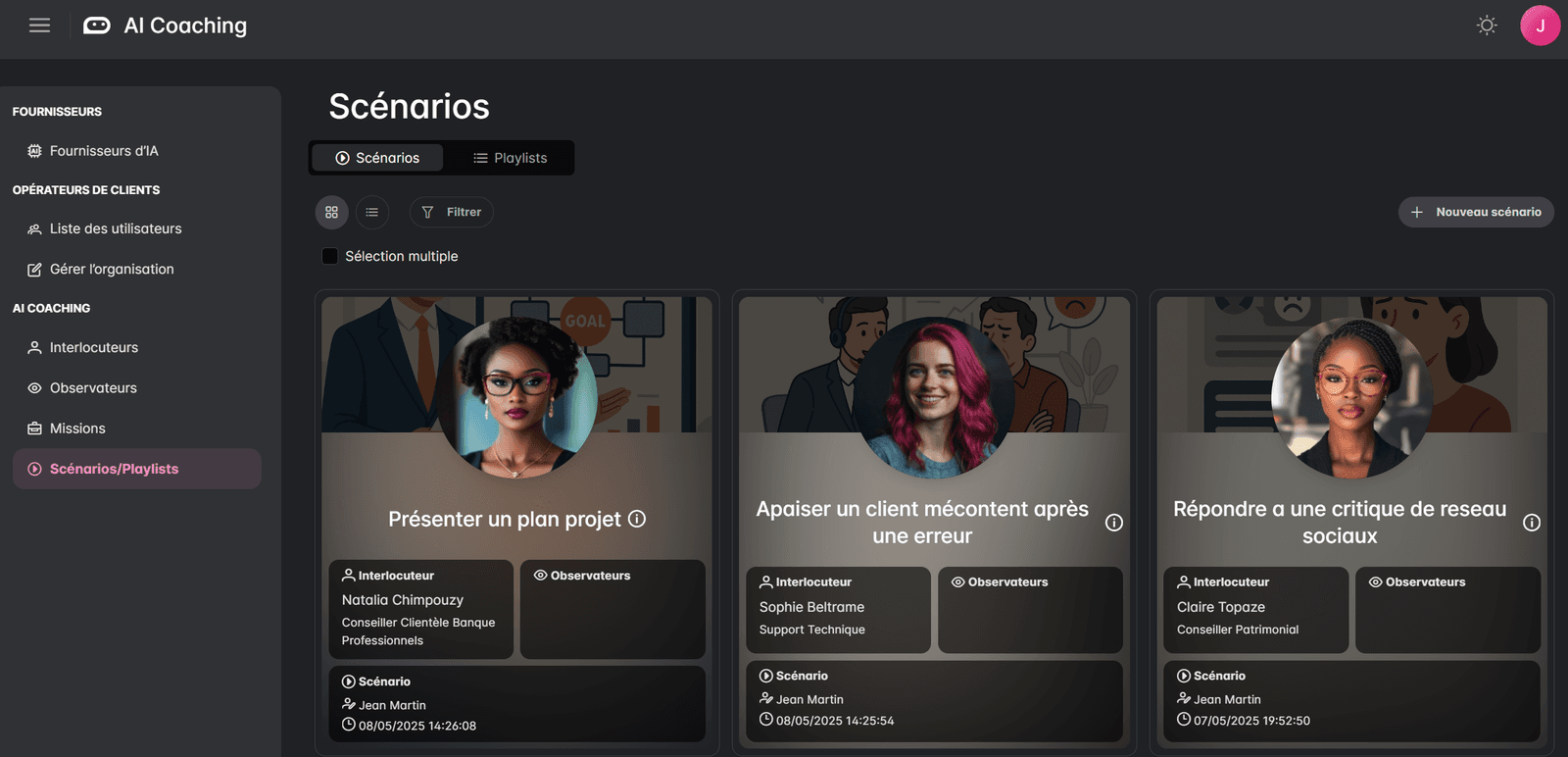
The free AI-Coaching demo includes a "Coaching CNV" scenario: you practise nonviolent communication with a coach, in text or voice, without creating an account. You get discreet tips during the exchange and a detailed debrief at the end. Pick the scenario in the demo (the list of scenarios changes over time).
To go further with a team, AI-Coaching lets you configure your own characters (a defensive employee, a demanding customer, a closed-off colleague), enrich scenarios with your internal documents, play in text or voice, track progress by skill and share learning paths through secure links. If you train managers, see our page on training managers, or request a demonstration tailored to your context.
Frequently asked questions
What does OSBD stand for in nonviolent communication?
OSBD is the French acronym for the four steps of the model: Observation, Sentiment (feeling), Besoin (need), Demande (request). You describe a fact without judgement, name what you feel, identify the need behind that feeling and make a concrete request the other person is free to accept or decline. The English equivalent is OFNR.
Does NVC work with someone aggressive?
It offers no guarantee of results, but it helps you stay in control of your own reaction. Empathic listening (guessing the feeling and need behind the aggression) often defuses tension, but sometimes you first need to set a clear limit, or even end the exchange. It does not replace a formal procedure in cases of harassment or threats.
How can I practise NVC on my own?
Keep a short journal: for each tense situation of the day, write the observation, feeling, need and request you could have expressed. Then say them out loud, for instance in front of a mirror or using the exercises above. Progress comes from frequency more than from duration.
Can I practise nonviolent communication with an AI?
Yes. A virtual conversation partner lets you rehearse a difficult conversation without exposing a real person. The free AI-Coaching demo includes a "Coaching CNV" scenario with a nonviolent communication coach. An AI remains a practice tool: it prepares you, but it does not replace real-life practice or support from a certified human trainer.
Tags
Share this article