Table of contents
Search for a “B2B cold calling script” and you mostly find paragraphs to read aloud. But a cold call is not won by reading. It is won in the first thirty seconds, with a clear opening, a request for permission and a question the prospect actually wants to answer. A good script is a call framework, not a monologue.
This guide gives you the structure of a call in six steps, five complete scripts (a meeting with a small-business decision-maker, a follow-up after a trade show, a callback on an inbound request, a referral, and a dormant-customer reactivation), eight replies to the objections that block the call, and the mistakes that cost the most. It ends with a method for rehearsing your script out loud before you dial. To play a first call right now, try the free demo, no account needed.
A script is a framework, not a text to recite
On the phone, the prospect has only your voice. A sentence that is read sounds read, and they hear it within two seconds. The script is not there to say everything. It is there so you do not improvise the critical moments (the first sentence, the reason for the call, the request for a meeting), so you can find your place when you are interrupted, and so you can compare what works from one call to the next.
Write it in short, spoken sentences, then learn the ideas, not the words.
B2B cold calling script: the structure of a call in six steps
1. The opener
Say who you are and why you are calling in one sentence, with no empty phrases such as “I just wanted to reach out.” A name, a company, and a piece of context that shows the call is not random (a hire, a trade show, a company announcement).
2. The permission
Ask for the right to continue. “I know I’m calling out of the blue. Can I tell you in two sentences why, and you tell me whether it’s worth going further?” acknowledges the interruption and hands control back, which defuses the instinct to hang up.
3. The reason for the call
A problem you help people in their position solve, plus the reason you are calling them in particular. Two sentences at most, and no feature list.
4. The opening question
An open question about their current situation, tied directly to the reason for the call. It turns a monologue into a conversation. To build your questions, lean on our guide to sales discovery questions.
5. Handling the brush-off
“Just send me an email,” “I don’t have time,” “we already have a vendor”: these replies come up constantly, so prepare for them. The pattern never changes: acknowledge without arguing, ask one question, offer a shorter frame. The eight most common cases are covered below, and the general method is set out on our page about handling sales objections.
6. Booking the meeting
Offer a specific time slot, with two options, a stated length and what the prospect gets out of it. Confirm in writing right away. A successful cold call ends with a date, never with “let’s catch up sometime.”
Five complete B2B cold calling script templates
The names, companies and offers below are fictional. Replace what is in brackets and keep the mechanics.
Template 1: booking a meeting with a small-business decision-maker
Target: the owner of a small maintenance company. Fictional offer: route-planning software for field technicians. Goal: a 20-minute meeting.
You: “Hi Ms. Lambert, it’s Julian Moore from [your company]. I’m calling out of the blue. Can I tell you in two sentences why, and you tell me whether it’s worth going further?”
Prospect: “Go ahead.”
You: “We help owners of maintenance businesses plan their technicians’ routes without spending their mornings on a spreadsheet. I’m calling because you’re hiring two technicians right now, and scheduling gets messy fast when a team grows. How do you plan routes today?”
Prospect: “A shared spreadsheet, and a lot of phone calls.”
You: “I’d like 20 minutes to show you how we handle a last-minute change in this kind of setup, and you can tell me whether it’s useful. Would Tuesday at 10 a.m. or Thursday at 4 p.m. work better?”
Variation if she pushes back. “I don’t have time for this.” → “Understood, it’s a topic for busy people. Ten minutes is enough to know whether a real meeting is worth it. Would Thursday at 8:30, before your day starts, work?”
Why it works: the reason for the call rests on a verifiable signal, the question is about her process rather than your product, and the time slot is specific.
Template 2: following up after a trade show
You talked for three minutes at a booth and the business card is sitting in your pocket. Call within the week, while the memory is fresh, and pick up what was said.
You: “Hi Mr. Garnier, it’s Claire Dubois from [your company]. We spoke last Thursday at [show name] about the service reports your teams fill in at the end of the day. Do you have two minutes?”
Prospect: “Oh yes, I vaguely remember.”
You: “You told me that doing the paperwork at the end of the day was a pain point. Have you made any progress on it since the show?”
Prospect: “Not really, we’ve had a lot going on.”
You: “That’s common after a show. Rather than send you a brochure, I’d suggest 25 minutes with your operations manager to look at one of your actual reports and see what could be simplified. Wednesday or Friday morning?”
Template 3: calling back an inbound request
A prospect filled in a form or left a message. This is a warm call, but not a won one: call back fast, and qualify before you present anything.
You: “Hi Ms. Perrin, it’s Sarah Lemaire from [your company]. You asked yesterday for a callback about [your request]. Do you have five minutes now, or shall I call back at a better time?”
Prospect: “Yes, go ahead.”
You: “Thanks. Before I tell you anything about us: what made you reach out?”
Prospect: “We’re looking to replace our current tool. It’s too slow.”
You: “Too slow for what, specifically? And who else on your team is affected?”
Prospect: “Mostly scheduling. About fifteen of us use it.”
You: “From what you describe, the most useful next step is a 30-minute demo with you and someone from scheduling who uses it every day. What’s your timeline for switching tools? I’ll plan the demo around it.”
Why it works: the prospect has already raised a hand, so the job is to understand why (motive, people involved, timeline), not to run through your presentation.
Template 4: a call based on a referral
Someone recommended you to the prospect, and they have agreed that you can use their name. Without that explicit agreement, do not use this template.
You: “Hi Mr. Benali, it’s Thomas Roche from [your company]. Pierre Martin, the director of [his company], suggested I call you. He thought [your topic] might be relevant to you. Is this a good moment for two minutes?”
Prospect: “Pierre? Yes, we know each other. What exactly did he tell you?”
You: “Only that you were thinking about how you handle this. I don’t want to speak for him. I’d rather understand your situation. Where are you on this topic?”
Prospect: “We’re starting to think about it, but nothing’s decided.”
You: “That’s the right time to talk, before the choices are made. I’d suggest 30 minutes to go over your context, no strings attached. Tuesday at 11 a.m. or Wednesday at 3 p.m.?”
Why it works: the referrer’s name lowers suspicion, but it does not sell for you. Never make them say more than they said.
Template 5: reactivating a dormant customer
A customer bought over a year ago and has not reordered. The goal of the call is to understand what changed, not to sell at all costs.
You: “Hi Ms. Fabre, it’s Nicolas Vidal from [your company]. We worked together in [year], and I haven’t heard from you since. I’m not calling to chase you for an order. I’d like to understand where you are now. Do you have two minutes?”
Prospect: “We stopped, yes.”
You: “Thank you for being straight with me. What made you decide not to continue?”
Prospect: “Budget that year, and then we just let it go.”
You: “If that need still exists, I’d suggest a 20-minute catch-up on what has changed on our side and what you need now. Early next month, mornings maybe?”
Why it works: candor defuses the awkwardness, and the reason they stopped may reveal a bad experience to address before proposing anything.
The eight most common objections that block the call, and how to answer them
Treat these replies as starting points. Adapt them to your own voice, never word for word.
| What the prospect says | What is often behind it | Sample reply |
|---|---|---|
| “Just send me an email.” | A polite way to end the call, or real curiosity | “Happy to. So it’s useful and not just one more email: what would you most like to see in it? I’ll send it today and call you Thursday for five minutes to get your reaction.” |
| “I don’t have time.” | A bad moment, not necessarily a no | “I figured, I’m calling out of the blue. When would be easier: Tuesday at 8:30 a.m. or Thursday at 5 p.m.?” |
| “We already have a vendor.” | No perceived stake | “Good, that tells me the topic matters to you. I’m not asking you to switch. What works well today, and what would you like to see improved?” |
| “I’m not interested.” | A reflex, or a real no | “I understand, you don’t know yet what this is about. Can I ask you just one question? If it doesn’t resonate, I’ll let you go.” |
| “What is this regarding?” (assistant) | A filter, not a refusal | “I’d like to talk with Ms. Lambert about how her technicians’ routes are planned. When is the best time to reach her?” Stay accurate: no lies, and no “it’s personal.” |
| “We don’t have the budget.” | No priority, or a genuine constraint | “I’m not asking you to buy today. When do you build next year’s budgets? A conversation now would let you size the topic beforehand.” |
| “Call me back in three months.” | A postponement, sometimes sincere | “Gladly. What will be different in three months? I’ll note the date and send you a short message before then, so my next call is useful to you.” |
| “Where did you get my number?” | Mistrust | “Your number is listed on [your source: website, professional directory]. I’m calling because of [reason]. If you’d rather not be contacted, I’ll note that right away.” Always say where the contact came from and honor opt-out requests. |
One rule applies to all eight: handle an objection once, not three times. After two clear refusals, thank them, record the reason and move on.
The mistakes that ruin a cold call
- Reading the script. A flat tone gives it away.
- Starting with yourself. A minute of company background before the first question, and the prospect has already hung up mentally.
- Opening with a closed question. “Do you use a planning tool?” invites a yes or a no. Prefer “How do you plan…?”
- Not preparing for the brush-off. Improvising in front of “just send me an email” almost always ends in giving in.
- Ending without a date. “I’ll follow up” commits no one. A date, a time, a participant and an agenda do.
Rehearse your script with an AI call simulator before you dial
A script has to be tested in real conditions, but each real prospect gives you only one chance. Practicing with a colleague helps, if they are available and demanding. An AI call simulator gives you on-demand practice you can replay as often as needed, without exposing a valuable contact.
In the AI-Coaching phone call simulator, the method comes down to five steps:
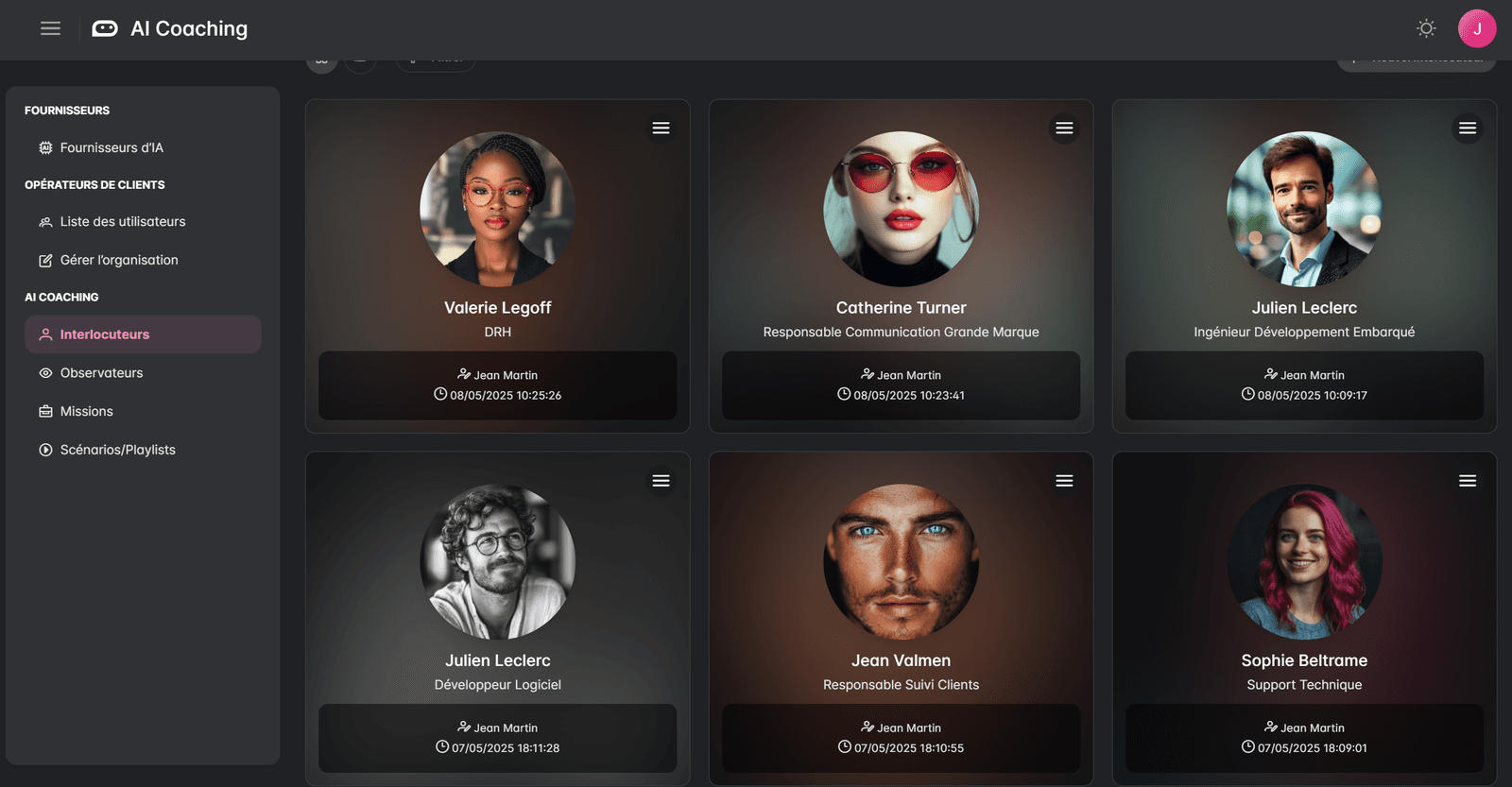
- Create the counterpart. Choose their role (small-business owner, executive assistant, operations manager), their personality (rushed, wary, courteous) and their AI profile.
- Give them your material. Scenarios can be enriched with your own documents: offer, sales pitch, call outline. The counterpart then reacts to your actual proposal.
- Play by voice or in writing, in your team’s language. Voice brings out what reading hides: pace, hesitations, silences.
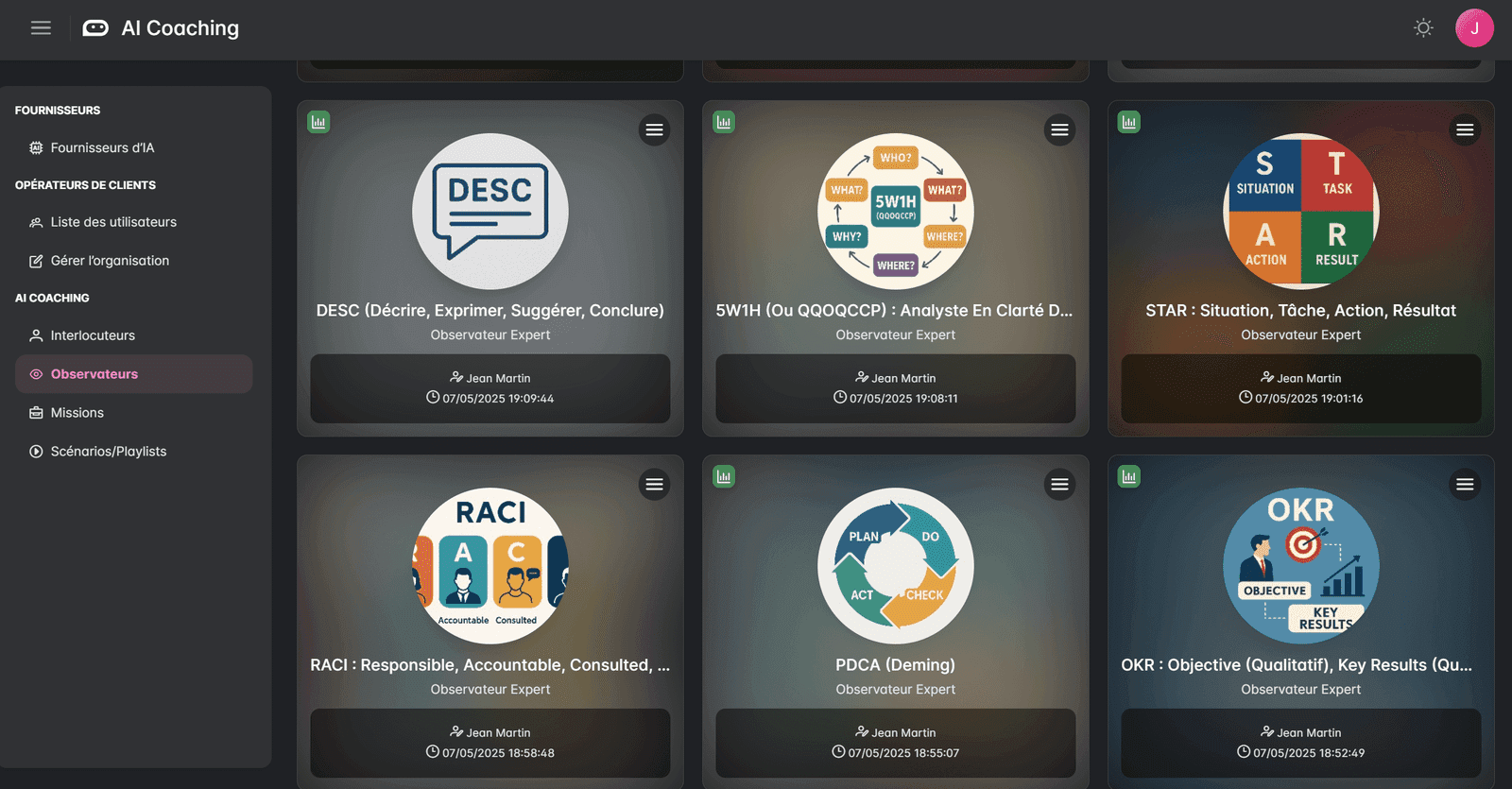
- Let the AI observer follow you. During the call it coaches you in real time. At the end, a detailed debrief reviews your opener, permission request, opening question, handling of the brush-off and meeting request.
- Replay, then raise the difficulty. Redo the call with the same profile to compare, then with a tougher counterpart. Progress tracking and the skills mapping show how you evolve from one session to the next.
For a team, learning paths and playlists let you chain the five templates above, from the simplest to the most demanding, and secure link sharing means nothing has to be installed. Our guide to AI sales roleplay describes the general principle and the scoring grid for sessions.
Want to see what it looks like? The online demo is free, needs no account, and works in text or voice. Among other scenarios it offers “Recruitment: first phone contact” and “Selling a TV to a customer.” Those are not B2B cold calls, but they show the format, the coaching and the debrief. The list changes. For a setup built on your own offers and targets, request a demo.
Frequently asked questions
Should you read a script word for word on the phone?
No. Reading produces a flat tone and keeps you from listening. Write the full script once to clarify your thinking, then cut it down to a page of keywords. Only the first sentence and the meeting request are worth memorizing as written.
How long should an opener be?
A few seconds: your name, your company and a reason for calling fit in one or two sentences. If it cannot be said in a single breath, it is too long. The goal of the opener is not to convince but to earn permission to ask your first question.
Can one script work for every target?
The structure can, the content cannot. Keep the six steps, but change the reason for the call, the opening question and the meeting you propose depending on whether you are calling an owner, a buyer or a dormant customer.
Can you practice cold calling without a real prospect?
Yes, with a roleplay. Facing a colleague, or a configurable virtual counterpart in an AI call simulator, you can rehearse the opener, the brush-offs and the meeting request as often as you need. You can start right now with the free demo.
Tags
Share this article