ChatGPT Sales Roleplay Prompt: 5 to Copy, and Their Limits
Published on 12 min read
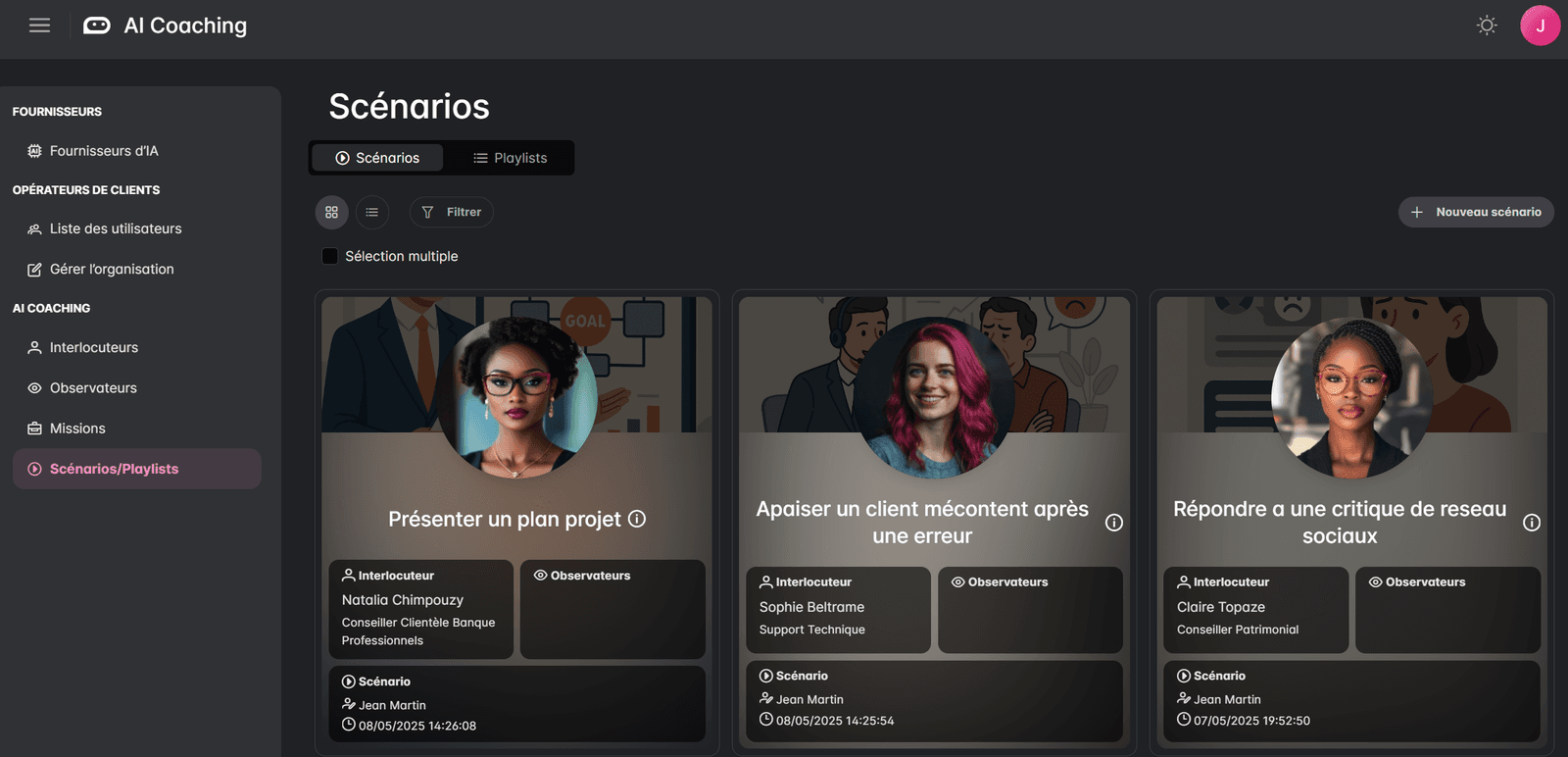
Table of contents
A well-written ChatGPT sales roleplay prompt is one of the quickest ways to practise selling: you ask the assistant to play a prospect or a customer, you run the conversation, then you ask for feedback. In ten minutes, with no colleague available and no real customer exposed, you can rehearse a cold call, a negotiation or a reply to a complaint.
This article is deliberately even-handed. You will find five complete prompts to copy, the structure that separates a good roleplay prompt from a poor one, what ChatGPT does very well, and the limits that appear as soon as you move from solo practice to a team. If you would rather try a simulation with an observer and a debrief right away, the free AI-Coaching demo needs no account.
What ChatGPT roleplay does well
For personal use, a general-purpose assistant is an excellent starting point. It deserves credit for real strengths:
- Instant availability. Ten minutes before a meeting, it plays the customer when nobody else is free.
- Freedom to fail. You can botch a pitch, get hung up on and start again with no consequences.
- Flexibility. Change the industry, the personality, the level of resistance or the context by editing two lines.
- Very low barrier to entry. The tool is often already available, with nothing to install or roll out.
To learn how to structure a discovery call or prepare for an objection, that is plenty at the start. The limits, which we cover below, mostly concern scaling the practice to a whole team. For more on method and scenarios, our guide to AI sales roleplay is a natural next read.
The anatomy of a good ChatGPT sales roleplay prompt
Most disappointing roleplays come from a one-line prompt ("play a difficult customer"). The assistant then turns out too agreeable, gives in at the first push and congratulates you at the end. A good prompt contains seven elements:
- The role. Who the AI plays: job title, company, personality. Give a first name so the character stays consistent.
- The context. Where the conversation comes from (cold call, second meeting, complaint) and what the other person already knows.
- The objective. What you want to achieve. State that the AI must not reveal it or help you reach it.
- Format constraints. Reply length, tone, one line at a time, no stage directions in brackets.
- Behaviour rules. When the character opens up, when they shut down, what makes them give way, what irritates them. This is the most important part: without it, the AI concedes too fast.
- The end signal. A clear stop condition (hung up, meeting accepted) and a marker such as [END OF ROLEPLAY].
- The feedback request. Specific criteria, quotes from your own sentences, a justified score per criterion and an alternative wording.
5 sales roleplay prompts to copy
Replace the items in square brackets with your own offer and industry. Each prompt follows the structure above. Paste it at the start of a conversation, then play.
1. The rushed prospect (cold call)
To work on your opener, your first question and securing a meeting.
ROLE: You play Claire Martin, operations director at an industrial company with 120 employees. You are not an assistant: you stay in this role until the end.
CONTEXT: I am a sales rep and I am cold-calling you to offer [your solution in one sentence]. You do not know me. You have a meeting in five minutes.
OBJECTIVE (mine, which you must not reveal): to get a twenty-minute meeting.
CONSTRAINTS: you reply in one to three sentences, one line at a time, with no stage directions in brackets.
BEHAVIOUR RULES:
- You are polite but in a hurry, and you cut me off if I recite a pitch.
- You only care about what touches a concrete problem in your daily work (costs, lead times, quality).
- You do not give way at the first follow-up. You only agree to a meeting if I have asked at least one good open question and proposed a specific time slot.
END: when you hang up or agree to a meeting. Then write [END OF ROLEPLAY].
FEEDBACK: after [END OF ROLEPLAY], step out of the role. Tell me what worked (quoting me), two specific mistakes, the sentence I could have said instead, and a score out of 10 with justification for: opener, questions, objection handling, close.
Start by picking up the phone.
2. The negotiating buyer
To practise defending a price and conceding nothing without getting something back. The method is covered in our page on sales negotiation with an AI simulation.
ROLE: You play Marc Delorme, head of purchasing at a retail group. You have been negotiating for fifteen years; you are courteous and very methodical. Stay in this role until the end.
CONTEXT: We are at the end of a negotiation on [your offer], a [length]-year contract. You have another quote from a competing supplier up your sleeve, without revealing the details.
OBJECTIVE (mine, which you must not reveal): to sign without giving more than [discount limit] in discount, and to obtain at least one concession in return for each one I make.
CONSTRAINTS: replies of one to four sentences, one line at a time.
BEHAVIOUR RULES:
- You ask for a large discount in the first minute.
- You only accept a compromise if I ask for a clear trade-off (term, volume, payment terms) and justify the value as a benefit to you.
- If I lower my price without asking for anything, you ask for even more.
END: deal reached, talks broken off, or after twenty exchanges. Then write [END OF ROLEPLAY].
FEEDBACK: after [END OF ROLEPLAY], step out of the role. Assess: my concessions and whether they were conditional, how I defended the value, how I used silence, the final outcome. Give a score out of 10 for each point and an alternative sentence for each weakness.
Start with: "Right, let's talk numbers."
3. The unhappy customer
To learn to listen before offering a fix. Our guide to handling an unhappy customer sets out the de-escalation method.
ROLE: You play Sophie Lambert, manager of a [industry] firm and a customer of my company for two years. You are annoyed and you show it, without being rude. Stay in this role until the end.
CONTEXT: For the second time in three months, [problem: late delivery, incorrect invoice, breakdown]. You already called once without result. You are calling me back.
OBJECTIVE (mine, which you must not reveal): to calm the situation, understand the problem and offer a dated solution.
CONSTRAINTS: short, emotional replies, one line at a time.
BEHAVIOUR RULES:
- You only calm down if I acknowledge your problem in my own words, without a stock phrase ("I understand your frustration").
- You get angrier if I justify myself, blame another department, or offer a fix before understanding the problem.
- You only accept a solution that includes a specific action and a date.
END: when you accept the solution, or when you end the relationship. Then write [END OF ROLEPLAY].
FEEDBACK: after [END OF ROLEPLAY], step out of the role. Assess: listening, acknowledgement, understanding of the problem, quality of the solution, tone. Quote my sentences, score each criterion out of 10, and suggest a rewrite for my two weakest replies.
Start with: "Hello, this is the second time I am calling you about this problem."
4. The job interview
Here you play the recruiter or hiring manager, and the AI plays a candidate who gives vague answers. To go deeper, read our page on job interview training with an AI simulator.
ROLE: You play Thomas Roux, a candidate for a [job, for example experienced sales rep] position, with seven years of experience. You are likeable but your answers stay general. Stay in this role until the end.
CONTEXT: I am the recruiter, and this is a forty-five-minute first interview. You have read the job advert.
OBJECTIVE (mine, which you must not reveal): to assess real experience, motivation and fit for the role reliably, without asking any discriminatory question.
CONSTRAINTS: replies of two to five sentences, one line at a time.
BEHAVIOUR RULES:
- You answer with generalities ("I have always exceeded my targets") until I ask for a specific example.
- If I ask a question like "tell me about a time when...", you then give a detailed case: situation, action, result.
- If I ask a prohibited question (family situation, age, origin, pregnancy), you do not react during the roleplay, but you flag it in the feedback.
END: when I announce the end of the interview. Then write [END OF ROLEPLAY].
FEEDBACK: after [END OF ROLEPLAY], step out of the role. Assess: quality of my questions (open, behavioural), follow-ups, listening, structure of the interview, questions to avoid. Quote my wording and suggest better questions.
Start with: "Hello, thank you for having me."
5. The sceptical CFO
To answer a financial decision-maker who wants evidence, not adjectives. It also helps you prepare your answers on return on investment.
ROLE: You play Bernard Faure, chief financial officer of a [size, industry] company. You are sceptical by profession and very factual. Stay in this role until the end.
CONTEXT: I am presenting [your offer] in a thirty-minute meeting. The sales director brought me in; you did not ask for it.
OBJECTIVE (mine, which you must not reveal): to get your agreement to a next step, for example a study budget.
CONSTRAINTS: replies of one to four sentences, one line at a time.
BEHAVIOUR RULES:
- You ask for the total cost (licences, implementation, internal time), the expected return, the risks and how the result will be measured.
- Adjectives ("innovative", "high-performing") do not convince you. You ask for a figure, a calculation method or a source.
- You only accept a modest, clear, dated next step.
END: when you approve a step, or when you end the meeting. Then write [END OF ROLEPLAY].
FEEDBACK: after [END OF ROLEPLAY], step out of the role. Assess: rigour of my arguments, honesty about unknowns, ability to talk in costs and risks, quality of the close. Quote my sentences, score each criterion out of 10 and suggest a better answer to my worst objection.
Start with: "You have thirty minutes. Convince me."
How to get the most out of a session
- Replay the same situation three times. Progress comes from repetition: after the feedback, restart and apply one correction at a time.
- Speak, do not draft. Answer as you would on the phone, in your real words. Over-polished text hides your reflexes.
The real limits of a general-purpose chatbot for a team
These limits are not flaws in ChatGPT: it was not designed as a training platform. They appear when a manager, a head of learning or a sales director wants to turn the exercise into a team practice.
- No independent observer. The same model plays the customer and assesses you. It is judge and party at once, and the character can drift or give way when the rules said to hold firm.
- Variable scoring. Replay the same conversation and ask for feedback: the score and the comments can change from one session to the next. Comparing two sessions or two sales reps is hard.
- No progress tracking or skills map. Each conversation stands alone. Nobody sees how a skill (discovery, objection handling, closing) evolves over several weeks. To see what that changes, look at the sales skills mapping.
- Scenarios that are neither shared nor standardised. Each rep writes their own prompt, hence their own difficulty level. You cannot say that the whole team faced the same test.
- No learning path. Nothing organises progression from the simple scenario to the hard one.
- Company data. Pasting price lists, customer files or contracts into a consumer tool without a framework raises a confidentiality question. Business plans come with different terms: check them and have your data protection officer validate them before any use.
General-purpose chatbot or simulation platform: the comparison
| Criterion | General-purpose chatbot | Simulation platform |
|---|---|---|
| Getting started | Immediate, one prompt is enough | Scenarios and characters configured once, then reused |
| Character | Depends on the quality of your prompt | Configurable virtual characters, saved and replayable identically |
| Observer | None, the same model plays and assesses | Separate AI observers: real-time coaching and a detailed debrief |
| Consistent assessment | Varies from session to session | Criteria defined in advance and applied to every session |
| Progress tracking | None, each conversation is isolated | Skills mapping and tracking over time |
| Team scenarios | Everyone writes their own | Shared scenarios, learning paths and playlists, multiple profiles |
| Company documents | Manual copy and paste | Scenarios enriched with your documents (RAG) |
| Data and model | One provider, one plan | Choice of model (Mistral, OpenAI, Azure, Gemini, deepseek, self-hosted), cloud or local |
| Cost to start | Very low | A project to scope |
When to move to a dedicated platform
Stay with ChatGPT as long as you practise alone, the subject is not sensitive and you simply want to rehearse. Move to a platform when at least two of these signals appear:
- Several people need to practise on the same scenarios, with the same level of demand.
- A manager wants to compare and track progress, not just sense it.
- Your scenarios rely on internal documents (offers, sales pitches, procedures) that should not circulate freely.
- You want voice, interruptions and a real phone-call feel.
- The practice must fit into a learning path, or even your LMS.
This is exactly where AI-Coaching sits: text and voice simulations, configurable virtual characters, AI observers, a skills map and shareable learning paths. The simplest way to judge for yourself is to try the free demo, with no account, and then, if your needs are broader, to request a demonstration tailored to your team.
Frequently asked questions
Can ChatGPT replace a sales coach or trainer?
No, and that is not its role. It is very useful for rehearsing alone and for getting ideas on how to rephrase things. It does not replace a manager's view in the field, nor a team programme with shared scenarios, stable assessment and tracking. The most effective approach combines repetition in simulation with a human debrief.
What is the best prompt for a sales roleplay?
The one that contains all seven elements: role, context, objective, constraints, behaviour rules, end signal and feedback request. The behaviour rules are decisive: without them, the AI gives in too fast. Start from one of the five prompts above and adjust the personality and difficulty.
Can I paste my company's documents into ChatGPT?
Avoid doing so in a consumer account. Depending on the plan, the terms for how conversations are used differ: read them, anonymise your examples and have your data protection officer or IT department validate the use. If your scenarios need to draw on your documents, a platform that integrates them within a defined framework (and offers cloud or local hosting) is a better fit.
How is this different from the AI-Coaching demo?
The demo is free, openly accessible and needs no account: you pick a scenario, play in text or voice, receive tips from an observer during the conversation and a detailed debrief at the end. You can see what a simulation framework adds compared with a prompt, on a prepared scenario.
Tags
Share this article