
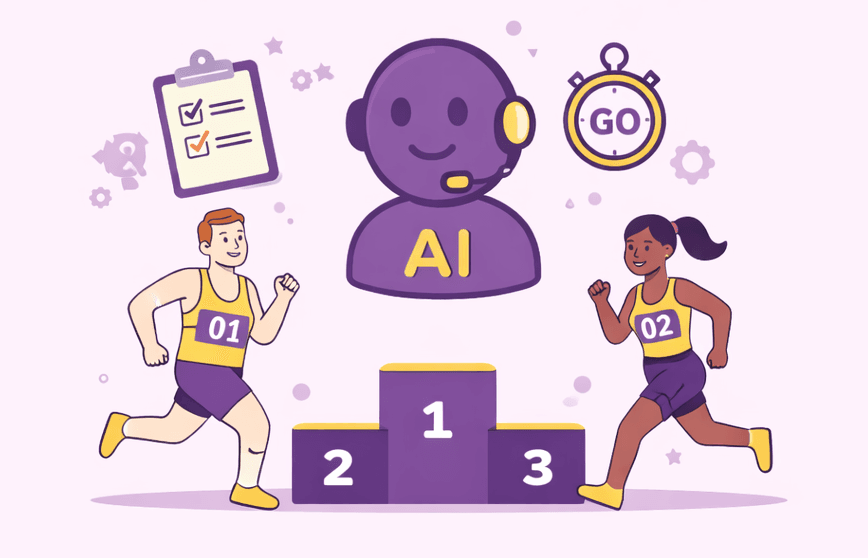
A surgeon spends years simulating operations before operating on their own. An airline pilot accumulates hundreds of hours in a simulator before their first commercial flight. A top athlete repeats the same movements thousands of times. Sales is just as demanding a profession—yet most salespeople learn on the job, directly with real prospects, without a safety net.
There AI-powered business simulation is changing this paradigm. It allows teams to be trained in conditions close to real-life situations, with immediate feedback, unlimited repetition, and objective measurement of progress.
What is an AI-powered business simulation? A precise definition
An AI sales simulation is an interactive training environment where a salesperson interacts with a AI-powered virtual prospect or customerUnlike a traditional role-playing game with a colleague or trainer, AI simulation offers several decisive advantages:
- 24/7 availability The salesperson can train whenever they want, as much as they want.
- Controlled unpredictability Each session is different, just like in real life.
- Lack of judgment The salesperson can fail, start over, experiment without social pressure
- Immediate objective feedback : not a subjective evaluation by a manager, but a structured analysis powered by AI
- Total scalability : train 5 or 500 salespeople to the same standard, without proportional cost
Why repetition is the true lever of sales performance
In the psychology of learning, the concept ofautomaticity This refers to the moment when a skill becomes a reflex—it is performed without conscious effort. A good salesperson doesn't "think" about how to respond to "it's too expensive." They do it naturally, confidently, in a few seconds.
This automaticity is acquired only through repetition. Neuroscience research shows that it takes between 50 and 200 repetitions of a behavior for it to become a solid reflex. However, a salesperson who meets with 3 prospects per week might only encounter a serious price objection every 10 days. It would take them years to achieve automaticity.
AI simulation compresses this learning time: a salesperson can experience 20 price objections in one hour of training. In a few weeks, the reflex is developed.
The most effective AI simulation scenarios for sale
Cold prospecting: overcoming the fear of rejection
Cold calling is the most stressful part of the sales cycle. Most sales representatives under-prospect because the fear of rejection outweighs their sales motivation. AI simulations allow you to experience dozens of rejections, hang-ups, and "I don't have time" responses—and learn how to handle them calmly.
Typical scenarios:
- The prospect who hangs up after 10 seconds
- The telephone switchboard that blocks access to the decision-maker
- The prospect who asks "will you send me an email?" to end the conversation
- The busy prospect who "really doesn't have time"
Discovering needs: asking the right questions
This is the most overlooked phase. Many salespeople start pitching before they truly understand the prospect's context. AI simulation can play a prospect who provides vague information, forcing the salesperson to dig deeper with relevant open-ended questions. AI can also trick the salesperson into assuming they are asking questions.
Pitch and argumentation: finding the right value for each profile
A one-size-fits-all pitch is a mediocre pitch. AI simulation allows you to test different lines of argument depending on the decision-maker's profile.
- The CFO, focused on ROI and costs
- The CIO, focused on security and integration
- The CEO, focused on the strategic vision
- The operational aspect, focused on practicality and adoption
Handling objections: from weakness to reflex
The 10 most frequent objections account for 80% of sales roadblocks. AI simulation allows you to work on all of them in depth until the response becomes natural:
- "It's too expensive" → defense of value and ROI
- "We're already with a competitor" → differentiation and cost of switching
- "We don't have the budget" → requalification and prioritization
- "This is not a priority" → creation of urgency and stakes
- "I need to talk to my team about this" → managing multiple decision-makers
Negotiation: Maintaining your position under pressure
AI simulation can embody a professional buyer with a realistic pressure strategy: aggressive discount requests, well-constructed competitive comparisons, and deadline ultimatums. The salesperson learns to maintain their stance, emphasize the scope of the agreement rather than the price, and make intelligent concessions.
Closing: Requesting the signature with confidence
Closing is the most difficult skill to teach theoretically. It's a matter of timing, tone, and reading buying signals. Simulation allows you to rehearse the last 5 to 10 minutes of a sales meeting until the salesperson knows exactly when and how to trigger the commitment.
The accelerated learning curve: data and mechanisms
The most advanced AI simulation platforms allow for structured progression in levels:
- Level 1 Cooperative prospects, simple objections — building the base
- Level 2 : resistant prospects, multiple objections — resilience development
- Level 3 Professional negotiators, complex situations — advanced mastery
This gamified progression maintains motivation and avoids demotivation linked to simulations that are too difficult too early.
AI simulation vs. classic role-playing game: an objective comparison
| Criteria | Classic role-playing game | AI-powered business simulation |
|---|---|---|
| Availability | Planned, rare | 24/7, unlimited |
| Realism | Depends on the trainer | Consistent, dynamic |
| Objectivity of feedback | Subjective | Objective, structured |
| Social pressure | Strong (colleagues' gaze) | None |
| Possible repetition | Limited (trainer fatigue) | Unlimited |
| Marginal cost per session | High (formative time) | Almost nothing |
| Data and traceability | None | Complete, with historical records |
How to integrate AI simulation into your sales training program
AI simulation is not a replacement for your existing training—it's an additional training layer. Here's a 4-step approach:
- Diagnosis : Identify the 3 to 5 most problematic sales situations for your team (cold call, price objection, closing, etc.)
- Configuration Customize the scenarios according to your industry, target personas, and real objections — the more the simulations resemble your reality, the more effective the training.
- Gradual deployment Start with new recruits, then expand to existing teams
- Continuous monitoring Analyze dashboards, identify weakness patterns, and adjust scenarios based on market and offer developments.
The impact on key business KPIs
A well-implemented business simulation directly influences:
- Conversion rate Better objection handling = fewer lost deals
- Average basket : protecting value = fewer non-negotiated discounts
- Sales cycle length More structured discourse = faster decisions
- Appointment booking rate Better prospecting = more opportunities in the pipeline
- Profit margin Negotiation stance = preservation of margins
FAQ — AI Business Simulation
How long does an AI business simulation session last?
The most effective sessions last between 10 and 30 minutes. Short, frequent sessions (3 to 5 per week) are more effective than one long monthly session.
Do experienced salespeople also benefit from using AI simulations?
Absolutely. Senior salespeople can use simulations to prepare for specific strategic meetings, test new sales pitches following a product launch, or work on rare but critical situations (tenders, negotiations with major accounts).
Can the scenarios be customized for our sector?
Yes, it's absolutely essential. The best platforms allow you to integrate your own personas, your differentiating arguments, objections specific to your market, and scenarios based on real situations experienced by your team.
Does AI simulation also work for complex, long-term B2B sales?
Yes. Simulations can replicate sales cycles with multiple decision-makers, purchasing committees, and multi-criteria tenders. The complexity of the scenarios can be configured to suit your business reality.
How do you measure the progress of a salesperson in AI simulation?
Through dashboards that track score evolution for each criterion (listening, structure, objection handling, closing) across sessions, we can see precisely how each salesperson is progressing, compare levels between individuals, and identify targeted coaching needs.
Ready to move from training to coaching? Request a demo of our AI-powered business simulation platform and see the difference in 30 minutes.