
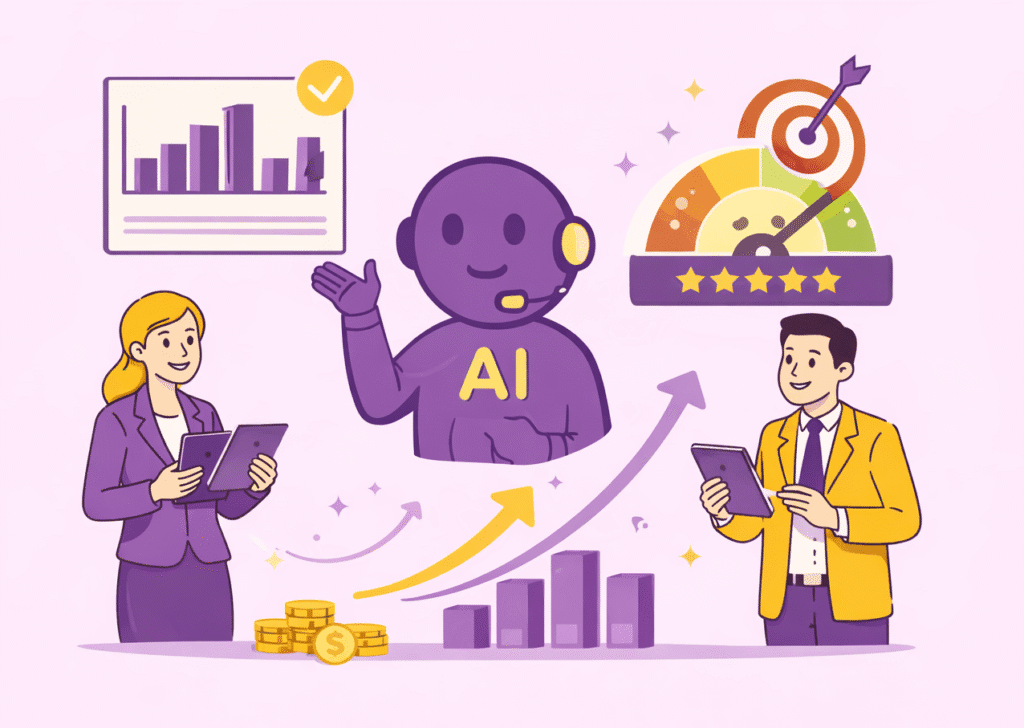
Sales coaching is the most underutilized investment for sales teams. Studies show that a good sales manager can increase their team's performance by 15 to 30%. Yet, the majority of managers spend less than 10% of their time actually coaching their teams—not for lack of will, but for lack of time, tools, and objective data. AI-powered sales coaching is changing this reality.
The problem with traditional sales coaching: too rare, too subjective, too time-consuming.
In most companies, sales coaching looks like this:
- A manager observes a call and gives subjective, verbal feedback.
- Role-playing games organized as team meetings, once a quarter
- A weekly one-to-one focused on current deals, not skills
The result: salespeople receive only a few hours of actual coaching per year. And when coaching does happen, it is often not followed by enough practice to solidify the behavioral changes.
AI coaching solves these three problems simultaneously:
- Frequency : training becomes continuous, on demand
- Objectivity The ratings are based on data, not impressions.
- Scalability A manager can coach 30 salespeople with the same effectiveness as 5
What is AI-powered sales coaching? Definition and how it works
AI-powered sales coaching rests on two complementary pillars:
1. Simulation training
The salesperson practices with AI-powered virtual clients in scenarios representative of their real-world situation. After each session, an analysis engine evaluates their performance on dozens of criteria (speech structure, objection handling, active listening, closing, etc.) and produces detailed feedback.
2. Data-driven management for managers
The manager has access to a consolidated dashboard that allows them to see, for each salesperson:
- Progression over time on each key skill
- Specific strengths and weaknesses
- Training frequency and level of commitment
- Collective patterns (weak skills across the entire team)
Coaching becomes data-driven, and no longer by intuition or post-meeting impressions.
The 6 situations where AI sales coaching makes a difference
1. Onboarding a new salesperson
The first few months are crucial. A new salesperson with immediate access to realistic simulations can practice key situations right from the start, without monopolizing the manager's time. They arrive at their first meetings with their first prospects already equipped with established reflexes.
2. Prepare for a strategic meeting
Before a major account meeting, a significant tender, or a tense contract renewal, salespeople can use AI simulation to test their pitch against the specific profile of the decision-maker they are about to meet. The AI can even be configured to embody a buyer with the known characteristics of that particular client.
3. Address an identified weakness
The manager identifies via the dashboard that a salesperson consistently struggles to overcome price objections. Rather than spending 30 minutes in theoretical one-on-one meetings, he prescribes five simulation sessions specifically focused on this objection. The salesperson returns with practical skills, not just theoretical advice.
4. Deploy a new pitch or a new offer
Launching a new product, changing positioning, or expanding into a new geographic area—every strategic shift requires rapid training for the entire team. AI simulation allows for the deployment of new scenarios in just a few days, ensuring that all sales representatives have mastered the new message before implementing it in the field.
5. Standardize the practices of a heterogeneous team
In many sales teams, performance is concentrated on 20 top performers who generate 80% of the results. AI simulation allows us to analyze what top performers do differently, codify it into scenarios, and teach it to others through repeated practice.
6. Coaching dispersed teams remotely
For multi-site or remote teams, in-person coaching is rare and expensive. The AI platform allows each salesperson to train from anywhere, and managers to track progress remotely with the same data as if everyone were in the office.
How AI coaching is transforming the role of the sales manager
AI coaching doesn't replace the sales manager—it allows them to play a more strategic role. Specifically, here's how the manager's time is redistributed:
| Activity | Before AI | After AI |
|---|---|---|
| Individual role-playing games | 4 to 6 hours/week | 1 to 2 hours/week (complex cases) |
| Post-call feedback | Subjective, one-off | Data-driven, targeted |
| Identifying coaching needs | By intuition | Via dashboard |
| Strategic coaching (deals, accounts) | Short time | More time available |
| Training of new recruits | Very time-consuming | Automated for 70 % of the route |
The objective measurement: the decisive advantage of AI coaching
One of the most complex challenges in sales management is the objective assessment of skills. How can you accurately measure a salesperson's listening skills? How can you compare the empathy levels of two support agents? How can you know if training from three months ago has actually produced behavioral changes?
The AI platform answers these questions with concrete data:
- Score per session : overall evaluation and evaluation by criterion after each simulation
- Time evolution : progress over 4 weeks, 3 months, 6 months
- Inter-team comparison : benchmarking between sales representatives or between teams
- Field correlation : cross-referencing simulation scores with real KPIs (closing, average order value)
This measure finally allows us to move from coaching based on perceptions to a Evidence-based coaching.
The winning hybrid model: AI + human
The most effective sales coaching in 2025 will be hybrid. Neither purely human (too rare, too subjective, not scalable), nor purely AI (lacking strategic nuance, contextual awareness, and situational emotional intelligence).
The optimal model is structured as follows:
AI takes care of:
- Daily or weekly simulation training
- Immediate and objective feedback after each session
- Measuring and monitoring progress over time
- Identifying patterns of collective weakness
The manager is responsible for:
- Strategic coaching on complex deals
- Analyzing the market context and relationship dynamics
- Motivation and human support
- Adapting the overall business strategy
Together, they form a coaching system that is more effective than either approach taken separately.
Impact on business KPIs: what the data says
Teams that have deployed structured AI sales coaching regularly observe:
- +12 to +25 % on the conversion rate within 6 months of deployment
- -30 to -50 % on onboarding time new recruits
- +8 to +15 % on the average basket thanks to better defense of value
- Reduction of intra-team variance The less skilled progress faster than the best.
- Improving sales team engagement Gamified training increases motivation
Checklist for successfully deploying an AI sales coaching program
- ✅ Define the 3 to 5 priority skills to work on (not all at once)
- ✅ Configure scenarios based on your real-world situations
- ✅ Set a minimum training schedule (e.g., 3 sessions of 20 minutes per week)
- ✅ Integrate AI scores into one-to-one manager/salesperson meetings
- ✅ Celebrate visible progress to maintain motivation
- ✅ Review the scenarios every 2 months to adapt them to market changes
- ✅ Cross-reference simulation data with field KPIs to validate the impact
FAQ — AI Sales Coaching
Is AI coaching suitable for senior salespeople who don't need to "learn the basics"?
Absolutely. For experienced professionals, simulations can be configured with advanced scenarios: multi-decision-maker negotiations, key accounts, relationship crises, and strategic tenders. The difficulty level is adjustable. Top salespeople often use simulations to prepare for specific, high-stakes meetings.
How to convince salespeople to engage in AI coaching?
The key is to present the simulation as a tool for personal development, not as a monitoring system. Salespeople who progress thanks to simulations see it very quickly in their field results—that's the strongest argument. The gamified approach (scores, visible progress, internal rankings) naturally increases engagement.
How much time should be dedicated to AI coaching per week?
The best results come from teams that practice 3 to 5 short sessions (15-20 minutes) per week. Consistency is more important than duration. It's just like sports: 20 minutes a day is better than a 2-hour session on Sunday.
Can the platform be integrated with our CRM or LMS?
The best AI sales coaching platforms offer native integrations with leading CRMs (Salesforce, HubSpot, Pipedrive) and LMSs on the market. This allows you to correlate simulation scores with real-world performance data recorded in your CRM.
What type of company benefits most from AI-powered sales coaching?
AI coaching generates a particularly strong ROI for companies with a sales team of at least five people, a sales cycle that includes negotiations, and a sufficient average order value for each deal won or lost to have a significant business impact. The B2B, SaaS, services, industrial, insurance, and telecom sectors are particularly well-suited.
Your team deserves coaching that matches its ambitions. Discover how ai-coaching.fr can transform your sales performance — first diagnostic session offered.